
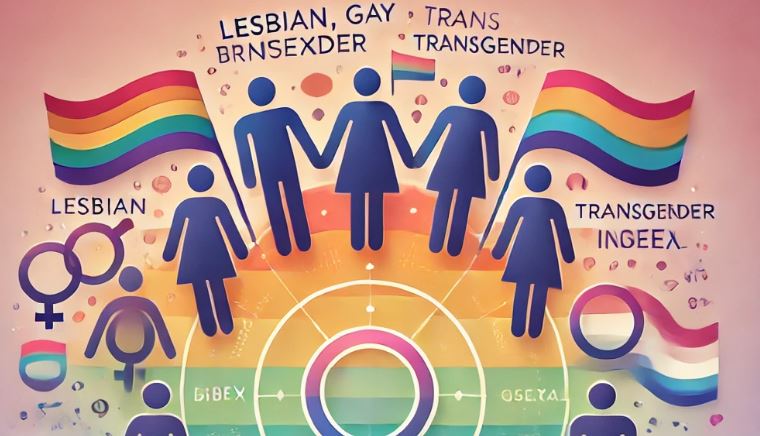
LGBTQIA+ Definition: Understanding the Acronyms and Their Meanings
The LGBTQIA+ community is a diverse group of people who identify as lesbian, gay, bisexual, trans, queer, intersex, asexual, and other related identities. Understanding the meaning of these acronyms and their significance is essential in promoting acceptance and inclusivity. In this article, we will provide a comprehensive guide to the LGBTQIA+ definition, including the meanings of the letters and the different identities they represent.
What is the LGBTQIA+ acronym ?
LGBTQIA+ stands for lesbian, gay, bisexual, trans, queer, intersex, and asexual, with the “+” symbol used to represent other related identities. These acronyms are used to describe individuals who identify as non-heterosexual, non-cisgender, or non-dyadic.
What do the letters in LGBTQIA+ mean ?
L – Lesbian: A term used for women who are sexually and romantically attracted to other women.
G – Gay: A term used for anyone who is attracted to the same sex.
B – Bisexual: A term used for individuals who are sexually and romantically attracted to both men and women.
T – Trans: An umbrella term used for individuals whose gender identity does not match the sex they were assigned at birth. This includes transgender, which is a term used for a person who identifies as a different sex from the one assigned at birth.
Q – Queer: An inclusive term used for people who identify as non-heterosexual and non-cisgender. It can also be used as a unique celebration of not conforming to social norms.
I – Intersex: A term used for individuals who are born with sex characteristics that do not fit typical definitions of male or female. This is not linked to gender but to biological sex.
A – Asexual: A term used for individuals who do not feel sexual attraction to either sex or do not feel romantic attraction.
Read also : What does queer mean in the LGBTQ+ Community ?
What are other related identities represented by the “+” symbol ?
The “+” symbol in LGBTQIA+ is used to represent other related identities, including pansexuality, which refers to a potential attraction without distinction of gender; two-spirit, an umbrella term referring to Native Americans who identify as having both a male and female spirit; and asexuality, which is used for individuals who do not feel sexual or romantic attraction.
How are these acronyms used in society ?
These acronyms are used to describe individuals who identify as non-heterosexual, non-cisgender, or non-dyadic, and are often used in expressions that relate to these people. For example, the LGBTQIA+ movement and LGBTQIA+ rights are examples of how these acronyms are used in society.
What is the importance of understanding the LGBTQIA+ definition ?
Understanding the LGBTQIA+ definition is essential in promoting acceptance and inclusivity. It helps individuals become more aware of the diversity within the LGBTQIA+ community and helps them to understand and respect the different identities and experiences of those within the community. It also helps to break down stereotypes and promotes a more tolerant society.
In conclusion, the LGBTQIA+ community is a diverse group of individuals who identify as lesbian, gay, bisexual, trans, queer, intersex, asexual, and other related identities. Understanding the meaning of these acronyms and their significance is crucial in promoting acceptance and inclusivity. By recognizing and respecting the different identities and experiences within the LGBT
LGBTQIA+ GLOSSARY : LGBTQIA+ meaning of each letter
Most women who are romantically and sexually attracted to women identify themselves as lesbians. “Few women use the term homosexual, specifies Marie-Pier Boisvert. Some say cheerful. Putting forward the term “lesbian” has been important in emphasizing the needs and differences of homosexuals, which are not necessarily the same as those of other women or of homosexuals. “To claim rights – social, in particular -, we must be able to name the realities more clearly”, believes Marie-Pier Boisvert. Dealing with lesbian claims may have prompted workers to reflect on their prejudices or to take note, for example, of the specificity of domestic violence between women.
SUBJECT
A gay man is a man who is romantically and sexually attracted to men. Easy, isn’t it? Not so fast. Highlighting the word “gay” has been a way for many men to assert their sexual orientation positively since “homosexual” has long had a pejorative connotation, in the sense that it referred to a time when loving a person of the same sex was seen as a mental illness. Marie-Pier Boisvert underlines that, nowadays, young gays no longer endorse this term, because it is perceived as an insult. Popular expressions copied from English tend to associate the word “gay” with something pejorative: “It’s so gay”, for example.
BISEXUAL
“This word, basically, designates a person who can be attracted to men and women on the romantic and sexual levels”, explains Marie-Pier Boisvert. However, it arouses criticism since it is based on the fact that there would be only two sexes, which is not unanimous in the LGBTQ communities. “It brings us back to the male-female binary system,” sums up Ms. Boisvert. Moreover, bisexual identity is perceived as a refusal to “connect” or an inability to “confess” being homosexual by some gays or lesbians. “To be bisexual is a political act in itself, as much in LGBT circles as in heterosexual communities”, believes Marie-Pier Boisvert.
SPIRITUALLY
In summary, Two-Spirit is the equivalent of queer , but in Indigenous communities. Elsewhere in Canada, LGBTQ organizations add “2S” (for “two-spirit”) at the end of the acronym to integrate these people. Marie-Pier Boisvert explains that, in the past, these people “were considered very valuable people, capable of understanding both the reality of men and women”. “As this non-binarity was inscribed in their hearts, they were assigned specific roles,” she continues. It was celebrated at one time [in Indigenous communities]. The Executive Director of the Conseil québécois LGBT believes that it is time to integrate two-spirited people as well as other LGBTQ identities into discussions in Quebec

TRANSGENDER
Transsexual and transgender are words that “move a lot” and which “have evolved very quickly over the past 30 years”, first specifies Marie-Pier Boisvert. Transgender refers to a person “who does not identify with the gender assigned to them at birth”. It should not be concluded that these people automatically have the feeling of being born in the wrong body. “A lot of trans people are very comfortable in their body, but are not comfortable with having to identify with a particular gender, she nuances. It’s the label that comes with their body that doesn’t fit. »
TRANSSEXUAL
The basic definition of the word transsexual is: person who has made a sex change. “A person assigned a boy at birth and who is now a woman by changing their name and legal status,” says Marie-Pier Boisvert. Does this mean that the person has undergone surgery or “completed their transition”, as the saying goes? “This word puts a lot of emphasis on the genitals, laments Marie-Pier Boisvert. Why is it so important what you have between your legs ? »
TRANS
Rather than using transsexual or transgender, Marie-Pier Boisvert suggests the term “trans”, period. That she deems more inclusive. “It includes all non-binary people, that is to say those who do not appear as men or women. Or both. Or in between. So when we talk about a trans person, it’s an umbrella term that can designate all these people. »

QUEER
Without a convincing equivalent in French – allosexual or altersexual remain little used – queer is not a synonym for bisexual. This term, like many other labels that have to do with gender expression and sexual orientation, has also carried different meanings and symbols over time. “What it means is that a person does not adhere to the idea that one falls in love with a sex in particular, but with a person”, says Marie-Pier Boisvert. To come out as queer is to oppose both “heterosexual conformity” and “LGBT letters”. The term queer , misunderstood even within certain LGBT communities, according to Marie-Pier Boisvert, carries with it the desire to transgress the limits imposed by gender.
INTERSEX
What sets them apart are their unique biological characteristics. They are therefore different from transgender people whose identity does not conform to their birth sex. Paradoxically, many intersex people unwillingly undergo surgeries and hormone treatments, while transgender people struggle to obtain them.
Asexual
Asexuality, in its broadest sense, is the state of a person not feeling sexual attraction to another person. A study published in 2004 estimates that the rate of asexual people is at least 1%.
Asexuality can also be considered as a spectrum, and therefore encompasses several sub-categories, for the best known we can cite Graysexuality, Demisexuality or even Aegosexuality.
Note that an asexual person may or may not have the urge to masturbate, asexuality and masturbation are not incompatible. Asexuality is also distinguished from celibacy and abstinence.

LGBTQIA+ meaning of each letter
[…] lgbtqia+ lexicon can sometimes be quite complicated to understand, here is why on this lgbt lgbtqia+ blog […]
WHAT IS AN ASEXUAL ?
[…] transgender are familiar to most people. However, words like asexual are terms related to the LGBT community whose meanings are still relatively unknown. This is why today we are going to answer […]
LGBT term explanation
[…] LGBTQIA definition […]
Gender Identity : A Guide for Allies
[…] LGBTQIA definition […]
LGBT movement
[…] LGBTQIA definition […]
LGBTQQIP2SAA meaning
[…] terms that mean very different things. And then there’s that complicated acronym, LGBT and LGBTQIA+. Let’s take a closer […]
Agender meaning : Definition of agender
[…] Dans notre société actuelle, il y a une prise de conscience croissante en ce qui concerne la diversité des genres et des identités de genre. Les termes tels que “agenre” sont de plus en plus utilisés pour décrire les personnes qui ne se sentent pas à l’aise avec les étiquettes binaires de genre. Dans cet article, nous allons explorer la signification du terme “agenre” et son importance dans la communauté LGBTQIA+. […]